
Innovation in Syria-related aid & assistance funds transfers
Germany successfully tests blockchain-based solution
Project overview
In a major milestone pilot, the German Federal Foreign Office, in partnership with PoliSync, successfully executed USDC stablecoin payments to Damascus via blockchain. The pilot reduced transaction costs by up to 73 per cent and significantly accelerated transfer times. It also improved accountability and compliance through a more transparent financial flow, demonstrating the feasibility of blockchain-based payments in high-risk and sanctioned environments.
PoliSync has successfully completed an 18-month research and pilot implementation project marking a historic milestone: Germany, a major government donor, directly tested blockchain-based solution for humanitarian and stabilization funds transfers to Syria using the USDC stablecoin - a non-volatile type of cryptocurrency pegged to the U.S. dollar.
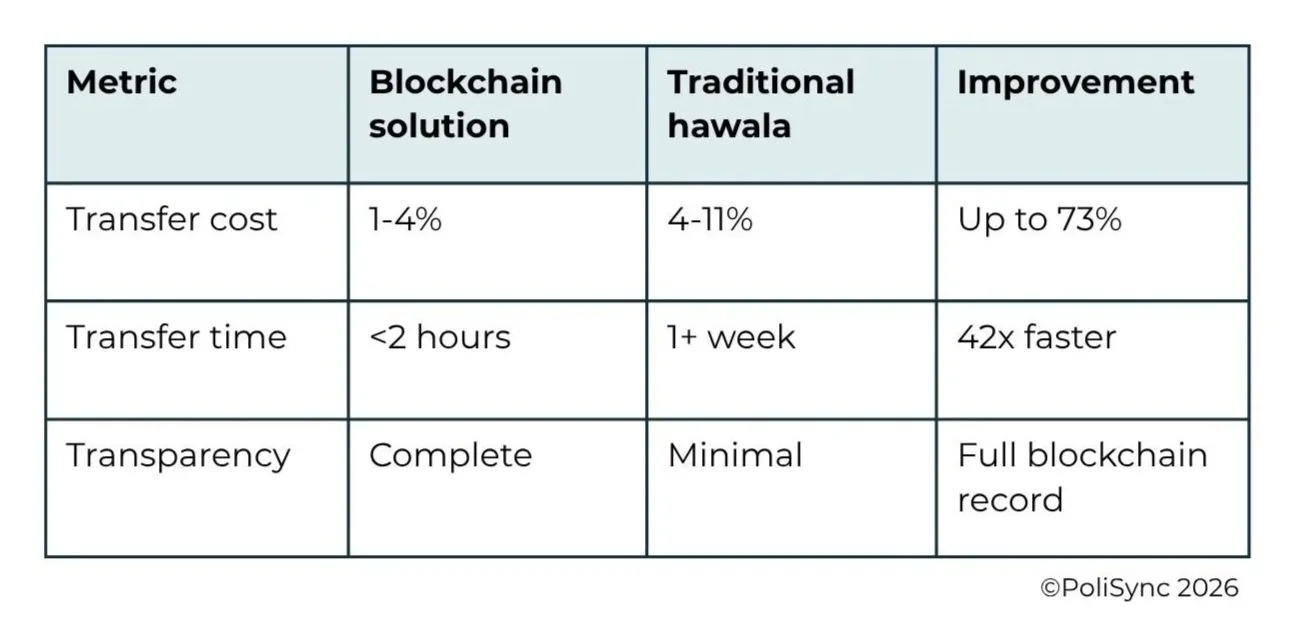
Funded by the German Federal Foreign Office (GFFO) through GIZ Stabilisation Platform, the project developed and successfully tested innovative stablecoin payment rails that reduced transfer costs from 4-11% to 1-4%, while completing on-chain settlements in under two hours, compared to more than one week using traditional methods.
The pilot validated regulatory-compliant USDC infrastructure operating through Syria — one of the world’s most challenging payment corridors — demonstrating institutional-grade stablecoin payment flows can meet rigorous government compliance standards.
Our approach

In-depth research
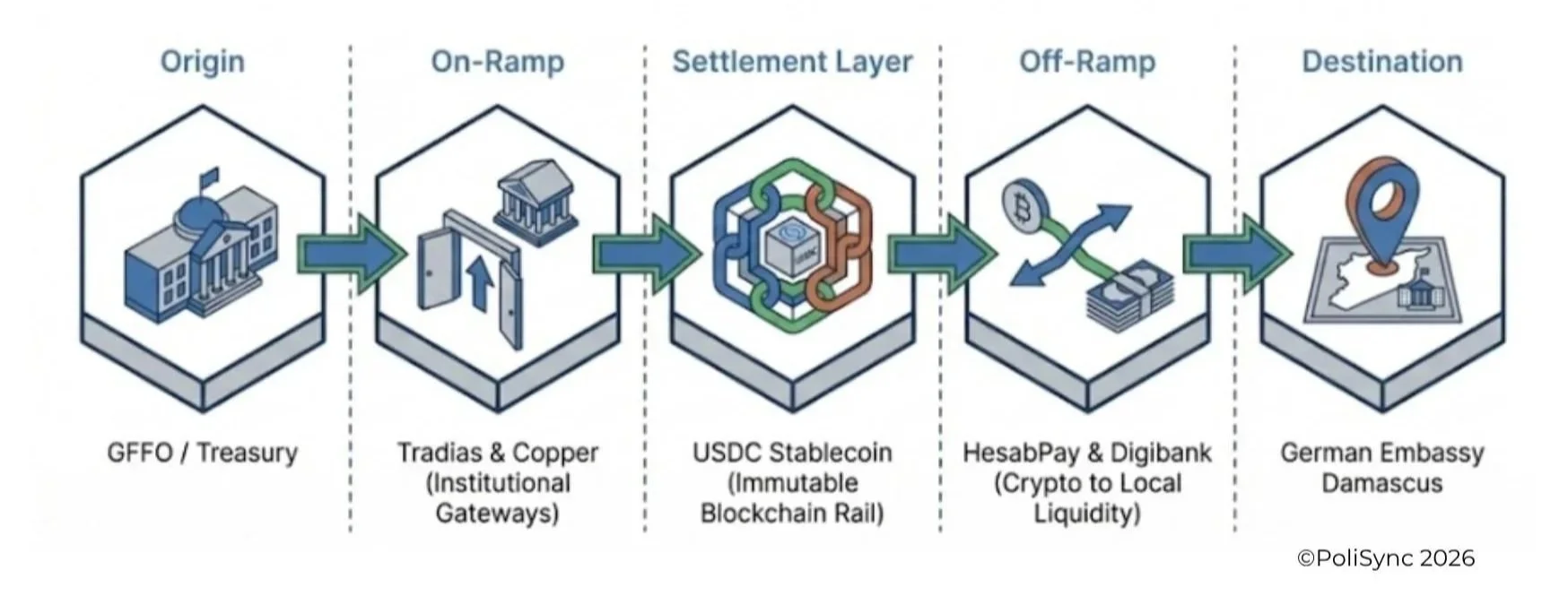
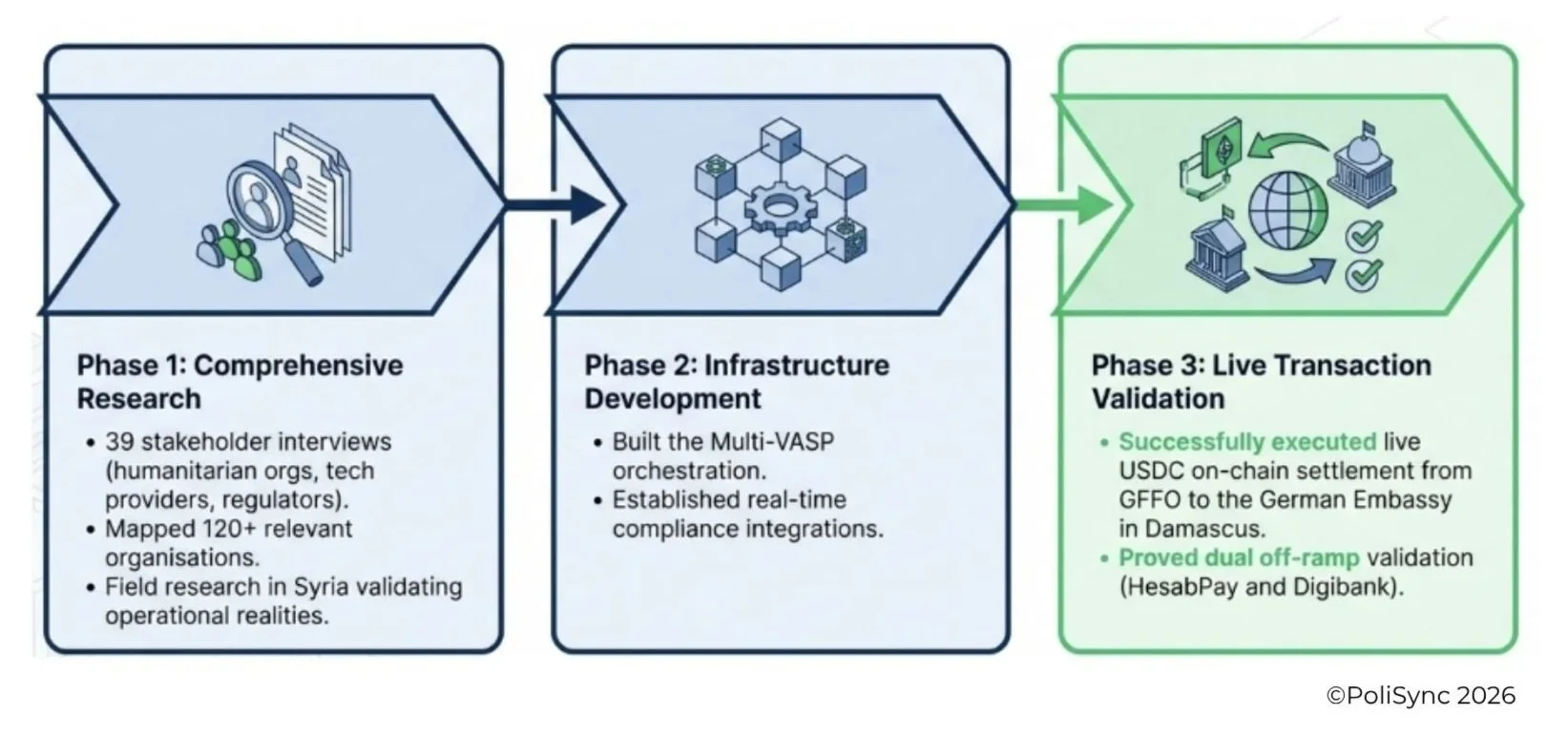
Conducted 39 stakeholder interviews across humanitarian organisations, technology providers & regulatory experts to assess prior use cases, key risks, and contextual challenges in humanitarian payments.
Mapped more than 120 relevant organisations and carried out field research in Syria to validate operational realities.

Developed & tested stablecoin payment infrastructure
Developed and successfully tested cross-border stablecoin payment rails with multiple Virtual Asset Service Providers (VASPs), covering on-ramping and currency conversion, on-chain settlement, and off-ramping (cash out) of funds from GFFO to the German Embassy Damascus.
Established blockchain-native treasury operations with real-time compliance integration aligned with German BaFin requirements and EU MiCA regulations, demonstrating scalability from proof-of-concept to production deployment.

Knowledge products & replication assets
Produced replicable research methodologies, a technology provider evaluation framework, comprehensive compliance architecture documentation, and operational procedures to guide adoption in comparable high-risk or constrained payment environments.
Key results
The pilot demonstrated clear operational advantages of blockchain-based humanitarian payments compared to alternative financial service providers (e.g. hawala). Across all key performance metrics — cost, speed, and transparency — the blockchain solution significantly outperformed existing transfer mechanisms. Transaction fees were reduced by up to 73%, settlement times decreased from more than one week to under two hours, and full end-to-end transaction visibility was achieved through on-chain records, addressing longstanding efficiency and accountability challenges in high-risk payment corridors.
Broader implications: Where stablecoin innovation meets humanitarian impact
This project emerges at a pivotal moment for both the humanitarian aid sector and the global stablecoin ecosystem. Recent developments, including the closure of USAID and broader reductions in humanitarian and development assistance as well as stabilization funding, have intensified pressure on donors and implementing partners to reduce costs while maintaining operational reach.
At the same time, high-level discussions at forums such as the World Economic Forum have increasingly focused on the practical deployment of stablecoins for cross-border payments and humanitarian aid. Global adoption by major financial institutions continues to accelerate, with stablecoin issuance reaching an all-time high of over $400 billion in 2026.
Against this backdrop, the project moves beyond conceptual debate, extending stablecoin implementation into one of the most challenging environments possible: a government-led deployment in a jurisdiction largely cut off from traditional financial channels due to a (formerly existent) comprehensive financial sanctions regime.
Stablecoins: Proving the use case in the hardest corridor
As global financial institutions increasingly converge on 2026 as a defining moment for stablecoins, this project delivers proof-of-concept in one of the most demanding operational environments imaginable. With stablecoin transaction volumes growing by approximately 75% year over year, the debate has shifted decisively from theoretical promise to real-world implementation.
This project addresses a critical question for policymakers, humanitarian actors, fintech and financial institutions alike: Can stablecoins meet institutional, regulatory, and operational standards under extreme conditions - and if so, where?
Syria combines nearly every constraint that undermines traditional payment systems: slow tangible effects of sanctions relief, the near total absence of correspondent banking, political instability, and severe infrastructure limitations. Humanitarian and other actors operating with the support of the German Federal Foreign Office and other donors must deliver assistance amid shrinking resources in a context shaped by more than a decade of conflict.
Successfully deploying USDC settlement rails in this corridor demonstrates the practical value of locally-accessible digital wallets and validates the resilience and scalability of stablecoin-based payments for both humanitarian and commercial applications. The very conditions that render Syria highly constrained for traditional finance make it an ideal environment for stress-testing stablecoin infrastructure.
Path forward
The project’s deliverables provide the German Federal Foreign Office with comprehensive evidence to support informed decision-making on potential scale-up. Should broader implementation be pursued, key considerations include continued alignment with relevant regulatory authorities, expanded stakeholder engagement to onboard humanitarian organisations as system users, coordination with other donors to share development and operational costs, and targeted infrastructure investment to increase off-ramp provider capacity across Syria.
The project's unexpected expansion from Northeast Syria to nationwide coverage following the December 2024 political transition further demonstrated the adaptability of the solution. Its ability to operate effectively amid evolving governance structures underscores its suitability for deployment in politically volatile and transitional contexts.
Meet the Core Team
-
![]()
Flore de Taisne
PROJECT DIRECTOR
Flore de Taisne has 15+ years experience across technology, emerging markets and social impact. She began her career working as an international development consultant in monitoring and evaluation for organisations including the UN, the World Bank and government agencies, across Afghanistan and the Middle East. In 2016 she co-founded ISHKAR, a company connecting customers with artisans in frontier markets, for which she was recognised as a Forbes 30 under 30 social entrepreneur. Most recently, Flore led and scaled the Middle East and North Africa operation at a global remittance fintech company, and now works as a cross-border payments expert and advisor for local and international organisations. Flore holds a History degree (BA) from King's College University, and a Double Master's degree in Economic Policy from London School of Economics and Sciences Po Paris. -
![]()
Sandra Uwantege Hart
STRATEGIST, INCLUSIVE INNOVATION & HUMANITARIAN ACTION
Sandra Uwantege Hart is a humanitarian specialist and consultant with 15 years experience managing humanitarian programs with UN agencies and INGOs in over a dozen countries globally, implementing projects in cash and voucher assistance, financial inclusion, food security, and livelihoods recovery. She now works as a technical expert, advisor and researcher for local and international organisations and social impact-focused companies exploring inclusive innovation. Currently, most of her work consists of being an interlocutor between the humanitarian and technology sectors - conceptualising, designing and managing community-inclusive, context-adapted Web3 (blockchain) and digital payment systems. In 2020, Sandra co-founded the startup Umoja Labs (formerly Emerging Impact) and is the award winning creator of Oxfam International's Unblocked Cash Project (2018-2021). Her work has been featured in academic publications, international conferences & speaking engagements, and media publications. Sandra is a dual national of Rwanda and the U.S. and holds an Anthropology degree (BA) from Princeton University, and a Master's degree in Development Studies from the Graduate Institute of International and Development Studies. -
![]()
Naledi Hollbruegge
DESIGN & DATA VIZ STRATEGIST
Naledi Hollbruegge is a data analyst and information visualisation specialist with extensive experience working with IOs, NGOs, governments, scholars and the private sector, as a data analyst, data visualisation specialist, and trainer. She is also a social researcher, experienced in academic research and the application of research methods and psychology principles in real-world settings. She is passionate about understanding social problems with data, using information visualisation as a communication tool and increasing impact by helping organisations become more evidence-driven. She holds a master’s in Social and Cultural Psychology from the London School of Economics.